Review Discovery
Gewch
Find brands through structured client reviews
Type
MVP
Stack
Next.js
Data
MongoDB
Host
Vercel
For a founder hiring: I can take a discovery MVP from idea to a public deploy without a five-person team.
Executive summary
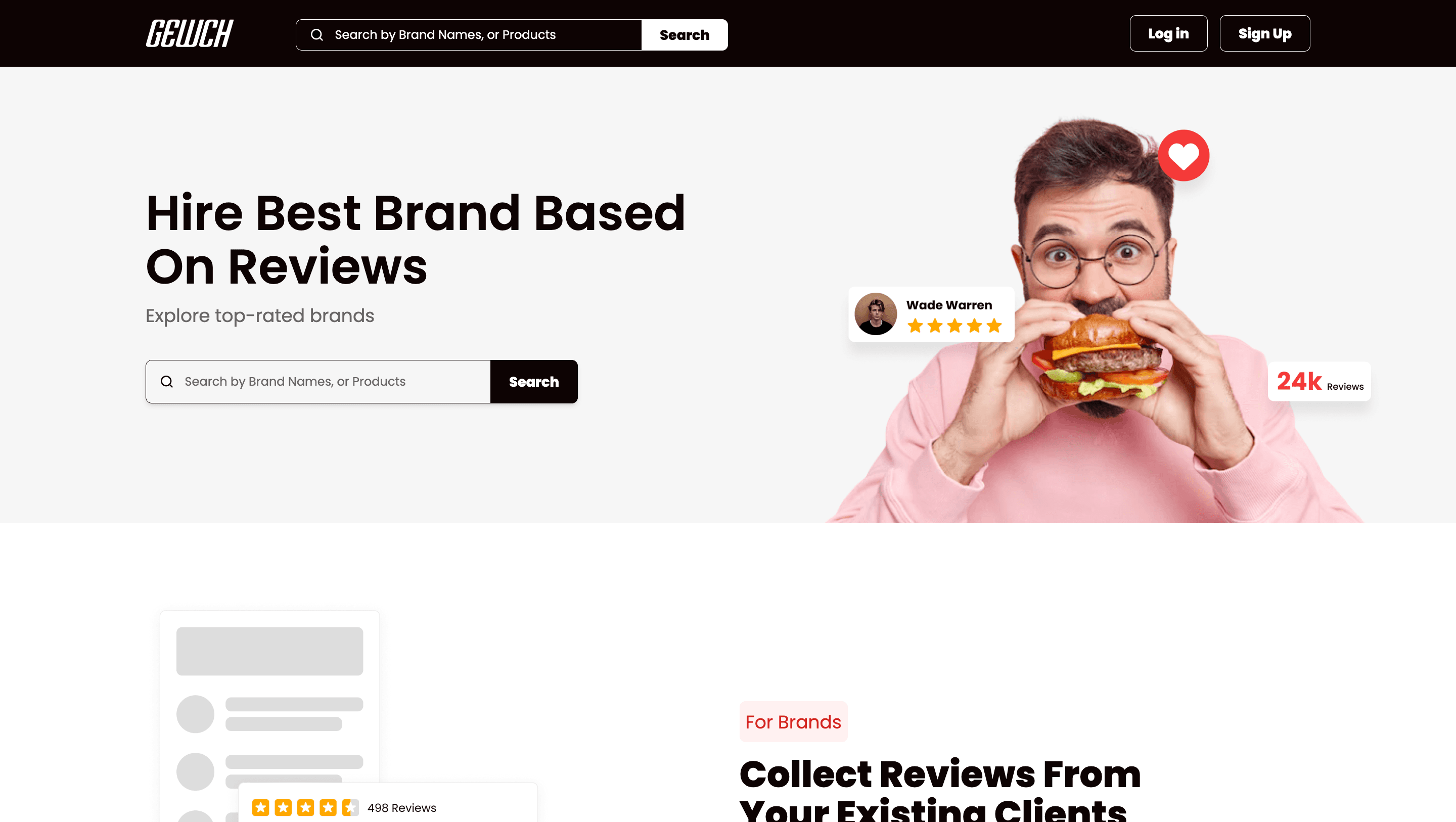
Gewch is a review-driven discovery MVP: browse brands and products through structured client reviews. I shipped a full-stack Next.js app to production so the idea could be tested in the wild — not stuck in a deck.
Why this product existed
Shoppers struggle to compare brands when review trust is fragmented. Products need a discovery layer built on structured, authentic ratings.
Business problem
Review trust is scattered. Without a clean browse experience on structured reviews, brand discovery stays noisy and hard to SEO around.
Why the existing approach failed
Generic review dumps and marketplace clutter don’t help someone compare brands quickly. An MVP needed structure and a public deploy, not another mockup.
Users
Shoppers browsing brands/products via reviews; early operators validating whether review-led discovery has pull.
Constraints
- Tight timeline to a public deploy
- Reviews structured for fast, trustworthy browse
- UI clean enough to avoid marketplace noise
- Full stack shippable by a small team
My responsibility
Full-stack — Next.js + Node + MongoDB
Architecture
Next.js frontend with a Node/Express API and MongoDB, deployed on Vercel. Focused on browseable review-driven UX rather than a full marketplace.
Engineering decisions
Next.js + Vercel for fast public ship
Why: MVP value is learning from a live URL, not perfect infra.
Rejected: Heavy multi-service setup before validation — slows the only loop that matters.
MongoDB for flexible review documents
Why: Review shapes evolve quickly in an MVP.
Rejected: Heavy relational modeling upfront before we knew which fields mattered.
Discovery-first UI, not full marketplace
Why: The bet is review-led browse — payments and inventory can wait.
Rejected: Building checkout and seller tools before proving discovery demand.
Hardest technical problems
- Structuring reviews for fast, trustworthy browse
- Clean discovery UI without marketplace clutter
- Shipping a full stack on a tight timeline
Trade-offs
- Ship speed vs. ranking sophistication — public MVP first, deeper trust/ranking later.
- Flexible documents vs. long-term query patterns — MongoDB helped early; harder queries may need revisiting.
- Narrow discovery scope vs. marketplace ambition — stayed narrow to finish.
Implementation
Built and deployed the browse experience for brands/products on structured reviews, with a full-stack Next.js path live on Vercel.
How the product evolved
Started as a validation deploy — a foundation for review-led SEO and brand discovery that can deepen ranking and trust features if the loop works.
What I’d do differently today
I’d define the thinnest review schema that still supports comparison, and instrument which browse paths convert curiosity into return visits before adding features.
Business impact
A foundation for review-led SEO and brand discovery — usable in production, ready to deepen ranking and trust features.
- Public production deploy
- Browseable review-driven UX
- Full-stack architecture in place
Lessons
- MVPs earn the right to complexity by shipping.
- Discovery products fail when UI noise outruns trust.
- A live URL teaches more than another architecture diagram.
Technology choices
- Next.js
- Node.js
- Express
- MongoDB
- Redux
- Vercel